NOTE: The URL of this blog is now www.thecsrbooksblog.com. Please make sure your RSS feeds / bookmarks are up-to-date!
Showing posts with label ethics. Show all posts

Tuesday, July 26, 2011

Corporate Social Responsibility: An Ethical Approach

Corporate Social Responsibility: An Ethical Approach
By Mark S. Schwartz

Published by Broadview Press.

ISBN: 978-1-55111-294-7

This review was first published on CSRwire.com on 25th July 2011


Description

Corporate Social Responsibility: An Ethical Approach. The term corporate social responsibility (CSR) is often used in the boardroom, classroom and political platform, but what does it really mean? Do corporations have ethical or philanthropic duties beyond their obligations to comply with the law? How does CSR relate to business ethics, stakeholder management, sustainability and corporate citizenship? Mark Schwartz provides a concise, cutting-edge introduction to the topic, analyzing many case studies with the help of his innovative "Three Domain Approach" to CSR. Corporate Social Responsibility also provides a chronology of landmark contributions to the concept of CSR and includes CSR resources on organizations, global codes and criteria, corporate CSR reports, and websites and blogs.

Commentary

Corporate Social Responsibility, for some of us, may have become a regular part of our approach to business, but the concept is still one that invokes debate about its real meaning, boundaries and scope. Even though we think we are clear about the underlying ethical foundations of CSR, sometimes a book comes along which raises questions that reinforce the fact there is no one right answer, no mathematical formula for ethics and no option but to go back to basics and rethink our underlying assumptions and values. CSR, at its root, is driven by ethical considerations as much as by strategic business thinking. Ethics may mean different things to different people but the need to recognize an ethical question and develop an approach to address it intelligently is common to all of us in business and, indeed, life. This is the contribution of Mark Schwartz' book, Corporate Social Responsibility: An Ethical Approach. Mark takes us back to first base and gives us a thorough grounding in the different aspects of the ethics debate, which should be part of the toolkit for all students of business ethics or managers of ethical businesses.

Mark Schwartz defines seven "moral standards" that can be used to analyze and guide the moral behavior of firms: Core Ethical Values, including trustworthiness, caring, responsibility and citizenship; Relativism; Egoism; Utilitarianism; Kantianism; Moral Rights; and, Justice/Fairness. If you don't know what differentiates each one of these, well, neither did I, so Mark's thorough explanation of each one was enlightening.

The heart of the book, however, is a grand debate between Milton Friedman and The Body Shop positions on a range of CSR-related case studies. Friedman and The Body Shop represent the extreme ends of the spectrum of business behavior and the conflict between profit and purpose. After a detailed analysis of both approaches, the author uses a set of case studies as the backdrop of an examination of the possible responses according to Friedman or The Body Shop. For example, how would Friedman have responded in the Ford Pinto case in which a design defect was potentially life threatening but a recall expensive? Would Friedman have advised pursuing profits and continuing sales without disclosure of the defect because the assessment was that even if an issue arose, it would be less costly to the company than the profit generated by maintaining sales? On the other hand, how would Anita Roddick, founder of The Body Shop, have responded in the Ford Pinto case? Is there any doubt at all The Body Shop would have recalled all cars known to be faulty? (Ford went the Friedman route and it wasn’t until 27 people had died and some years after the issue arose internally that a recall became unavoidable.)

Similar treatment is afforded to other cases studies on the Union Carbide Bhopal disaster, the Johnson and Johnson Tylenol contamination and the river blindness story and Merck, the pharmaceutical company. None of these cases are new to most of us, I suspect, but Mark Schwartz' treatment of them is fascinating and even somewhat entertaining.

Finally, Schwartz closes with his proposal for a new analytical tool for understanding the behavior of corporations. He calls this the Three Domain Model and it has three core parts: economic, legal and ethical (not people, profit and planet). This model is influenced strongly by Archie Carroll's Pyramid of CSR, but modified by Schwartz (for example, it excludes philanthropy, which, in the author's view, does not constitute a responsibility but more a discretionary activity). This is an interesting approach that could help students of CSR and managers in business understand and even guide motivations for decision making and the impacts of decisions on society and the environment.

Designed for use in the study of ethics and CSR rather than as a general interest book on ethics, Mark Schwartz provides an informative, creative and comprehensive discussion of business ethics from both a theoretical and practical standpoint. Oh, and if you don't know your Kantianism from your Utilitarianism, go read this book!


elaine cohen, CSR consultant, Sustainability Reporter, HR Professional, Ice Cream Addict. Author of CSR for HR: A necessary partnership for advancing responsible business practices  Contact me via www.twitter.com/elainecohen  on Twitter or via my website www.b-yond.biz/en

Saturday, June 11, 2011

The Whistleblower


By Kathryn Bolkovac and Cari Lynn

Published by Palgrave Macmillan

ISBN: 978-0-230-10802-8


Description

When Nebraska police officer and divorced mother of three Kathryn Bolkovac saw a recruiting announcement for private military contractor DynCorp International, she applied and was hired. Good money, world travel, and the chance to help rebuild a war-torn country sounded like the perfect job. She was soon shipped to Bosnia, where DynCorp had been contracted to support the UN peacekeeping mission. She was assigned as a human rights investigator, heading the gender affairs unit. The lack of proper training provided to her sounded an alarm bell, but once she arrived in Sarajevo, she found out that things were a lot worse than she imagined. At great risk to herself, Kathy began to unravel the ugly truth about officers involved in human trafficking and forced prostitution, and their connections to private mercenary contractors, the UN, and the U.S. State Department. Soon, she was demoted, then fired. Feeling threatened with bodily harm, she fled the country, bringing the incriminating documents with her. Thanks to the evidence she had collected, Kathy won a lawsuit against DynCorp, finally exposing what they had done. Here, Kathy warns of the inherent danger when we contract out our wars and that it is our responsibility to protect the weak and disenfranchised in times of peace. Both gripping and inspiring, this amazing true story of courage and honour in the face of insurmountable odds shows that just one voice can make a difference.

Commentary

Now an award-winning movie taglined "a drama based on the experiences of Kathryn Bolkovac, a Nebraska cop who served as a peacekeeper in post-war Bosnia and outed the U.N. for covering up a sex scandal," The Whistleblower is much more than that. It's an exposure of the worst kind of corruption, human rights abuse, vile self-interest, lies, fabrications and corporate cover-ups present at the intersection of the United Nations, the U.S. Government and military contractors who exploit tax-payers' money by complying with human rights crimes in the name of peace. It is also the compelling story of a woman who refused to remain silent about these abuses in the face of significant personal danger. It's a lesson for everyone involved in allocation of national budgets and procurement about the controls necessary to administer contractors and the way they fulfill their responsibilities. It's also a drama, a love-story, an action-packed thriller and a fascinating read. For anyone involved in corporate responsibility, it's a case study about ethics, human rights and the need to protect those who speak out about corrupt practices in business. Finally, it's a wake-up call to shake all those in positions of authority out of complacency and complicity and urge them to clean up the system.

Kathy Bolkovac's story begins when she applies for a role in the International Police Task Force (ITPF) in Bosnia in 1998. The organization providing these "rent-a-cop" services is DynCorp International, "a global government services provider in support of U.S. national security and foreign policy objectives, delivering support solutions for defense, diplomacy, and international development." In this case, the contract was in the framework of the UN mandated IPTF in Bosnia and Herzegovina (formerly Yugoslavia) following the Serbian attack on Sarajevo and the ensuing war for which Slobodan Milosevic was later charged with genocide. The ITPF is composed of UN member countries' national police force representatives. The U.S., not having a national police force, would play its role through providing the services of private contractors. Enter Dyncorp and their recruitment drive, which propelled Kathy Bolkovac to a role as a Human Rights Investigator.

It doesn't take the smart, conscientious and rather outspoken Kathy Bolkovac long to realized that all is not kosher in Sarajevo. She quickly starts to fight for the protection of female victims of domestic violence, winning a breakthrough court ruling which would serve as a base to advance programs addressing violence against women in the region, while unraveling the grim details of the involvement of DynCorp personnel in the trafficking of young girls across East European borders, detention of women for prostitution, visits to brothels and holding women captive for all of the above. After facing many setbacks (disappearing files, delaying tactics, intimidation, etc.) in trying to bring these issues to light, in 2000, Kathy sent a desperate email to 50 personnel involved in the Bosnia mission, entitled "don't read this if you have a weak stomach or a guilty conscience." The email detailed the difference between prostitutes and trafficking victims and the stages of how women end up as prostitutes and sexual slaves, imploring all involved in the mission to ensure they serve and protect people rather than playing a role in facilitating and engaging in human abuses and crime. Her boss immediately informed her that her email was "not a good idea" and Kathy was subsequently dismissed, ostensibly for falsification of work records, a claim which was entirely fabricated.

Bravely battling against all the corporate muscle DynCorp could muster, Kathy had her day in court (taking home a settlement of a mere $175,000) winning her case for unfair dismissal while exposing the illegal, unethical and irresponsible practices of DynCorp International and their poorly trained, inadequately managed and ineffectively deployed personnel. Kathy ends her account of her own story by making some recommendations on policies for police officers recruited for international missions. Kathy writes: "I have spent many sleepless nights… wondering why these blatantly illegal behaviors were simply allowed to be swept under the rug. And yet reports of immoral and illegal behavior among DynCorp's civilian peacekeepers …continue to make front page news with alarming regularity." You can get a sense of this from Corpwatch's Dyncorp page.

Beyond the personal story of heroine Kathy Bolkovac and the horrors of how she was treated for simply doing her job, as well as anger about the plight of defenseless women caught up in immoral exploitation, this book is an eye-opener about the inner workings of a highly profitable industry which should be head and shoulders above the rest in terms of protecting human rights, revealing it to be a hotbed of the worst kind of intrigue, politics and abuse. Questions about the responsibility of the U.S. government in monitoring the activities of its contracted service providers as well as the integrity of this multi-billion dollar corporation remain in your mind. Despite DynCorp's Code of Ethics, complete with Q and A's, The Whistleblower leaves you with a sense of despair that so much is yet to be done while few people are prepared to speak out and be accountable. The Whistleblower is a sobering, important read with all the romance, tension and intrigue of a bestseller title in the crime fiction category. Regrettably, this one is actually true. Oh, and I can't wait to see the movie.

elaine cohen, CSR consultant, Sustainabilty Reporter, HR Professional, Ice Cream Addict. Author of CSR for HR: A necessary partnership for advancing responsible business practices Contact me via www.twitter.com/elainecohen  on Twitter or via my website www.b-yond.biz/en

Tuesday, April 26, 2011

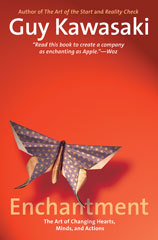
Enchantment: The Art of Changing Hearts, Minds and Actions

Enchantment Enchantment: The Art of Changing Hearts, Minds, and Actions


By Guy Kawasaki

Published by Penguin Books Ltd

ISBN: 978-1-58184-379-5


Description
Enchantment: The Art of Changing Hearts, Minds, and Actions is Guy Kawasaki's tenth book. In it, he explains how to influence what people will do while maintaining the highest standards of ethics. The book explains when and why enchantment is necessary and what the pillars of enchantment are: likability, trustworthiness, and a great cause. The next topics are launching, overcoming resistance, making enchantment endure, and using technology. There are even chapters dedicated to enchanting your employees and your boss. Finally, because there are times you may want to resist enchantment, there is even a chapter about how to do this too. If you want to change the world - or even part of the world, this book is for you.

Commentary
I usually review books about Corporate Social Responsibility (CSR) and Sustainability, and Enchantment does not pretend to fall into these categories. However, there is nothing more fundamental to ensuring a sustainable future than the preservation of relationships, ethics and positive interactions with all we meet and with whom we interact. In this sense, Enchantment is the ultimate required reading for CSR and Sustainability; it precedes and prepares us for the entire journey of changing the world based on universal values and respect for all.

Enchantment is not the product of a scientific research program nor is it a collection of corporate case studies that define sustainability processes. It is the product of Guy Kawasaki's collective experiences, coupled with his intelligent development of an innovative basic behavioral model which can be summarized in one sentence: Enchantment will save the world.

At the heart of this book, is a compelling definition of enchantment which gives this word new meaning and an empowering platform with which we can immediately identify. Enchantment "causes a voluntary change of hearts and minds and therefore actions. Enchantment transforms situations relationships. It converts hostility into civility. It reshapes civility into affinity. It changes skeptics and cynics into believers." When you want to enchant people, you want to fill them with "great delight".

The book, Enchantment, is a how-to guide, describing the multiple situations in which you can genuinely and authentically enchant your colleagues, friends, family, associates, employees, your boss and even yourself in order to promote a worthy cause. Ranging from "Disclose your interests" (a key component of trustworthiness), to "Conduct a Premortem" (preventing potential problems in order to increase the likelihood of success) to "Make it Short, Simple and Swallowable" (when creating marketing messages) to "Default to Yes" (adopt a yes attitude, which buys you time, enables you to see more options and builds rapport), the book is peppered with chunks of great advice on how to build an enchanting attitude, behavioral framework and actually, way of life. Enchantment also applies in the world of social media (maybe, especially in the world of social media), and Guy Kawasaki includes two chapters on enchantment in email, twitter, websites, blogs, Facebook and other online hangouts. One of my favorite sections is the one called "Think Japanese", where lessons from Japanese wisdom inspired by Garr Reynold's book, Presentation Zen Design, such as Kanso, Shizen, Datsuzuko, Seijaku, Wa and Ma, will "make people think you're smart and more enchanting" (unless you are Japanese and this is your mother tongue, I guess) and also provide some useful insights. Personal stories from interesting personalities are offered throughout the book, showing how they have applied or experienced enchantment in practice.

But, getting back to CSR and Sustainability. There are some enchantment themes which are directly relevant to sustainability programs. "Diversify the Team" is one. "A diverse team helps make enchantment last because people with diverse backgrounds, perspectives and skills keep a cause fresh and relevant." "Empower your employees to do the right thing" is another - because employees care, and "money isn't their sole motivation". Also, ethics gets a mention - "not everyone is an ethical enchanter" - and Guy makes the case for resisting situations in which ethics might be compromised - rather like Code of Conduct training.

All in all, this is a short book with a powerful message which, actually, does enchant as you read it. Guy Kawasaki radiates throughout his book a certain nice-guy authenticity which makes his message credible and gives you an insight into how he has achieved wide acclaim and success as founder of Garage.com and Alltop.com and advisor to many technology and social media ventures, as well as being a popular speaker and writer.

For all those struggling to sell CSR in organizations or those who want to achieve transformational results in promoting the cause of sustainability or simply improve relationships, Enchantment is well worth the read and will leave you, yes, enchanted.


elaine cohen, CSR consultant, Sustainabilty Reporter, HR Professional, Ice Cream Addict. Author of CSR for HR: A necessary partnership for advancing responsible business practices  Contact me via www.twitter.com/elainecohen  on Twitter or via my website www.b-yond.biz/en

Thursday, September 23, 2010

Giving Voice to Values


Giving Voice to Values: How to Speak Your Mind when You Know What's Right


By Mary C. Gentile

Publisher: Yale University Press ISBN-13: 978-0300161182

This review first appeared on CSRwire.com on 23rd September 2010


Description

How can you effectively stand up for your values when pressured by your boss, colleagues, customers or shareholders to do the opposite?

Educator Mary Gentile empowers business leaders with the skills to voice and act on their values and align their professional path with their principles. Her book, Giving Voice to Values, is inspired by a curriculum Gentile launched at The Aspen Institute with Yale School of Management, now housed at Babson College, with pilot programs in over 100 schools and organizations on five continents.

Challenging the assumptions about business ethics at companies and business schools, she argues that often the issue isn't distinguishing what is right or wrong, but knowing how to act on your values despite opposing pressure. Drawing on actual business experiences as well as social science research, Gentile offers advice, practical exercises and scripts for handling a wide range of ethical dilemmas. Published by Yale University Press, Giving Voice to Values is an engaging, innovative and useful guide that is essential reading for anyone in business.

Commentary

There is something, I think, that most people overlook in training on ethics and the assimilation of values in business, and that is how you actually put the theoretical knowledge in to practice. It's a little like knowing the calorie count of all the food on your daily menu, but having difficulty actually getting started with, and maintaining, that low-calorie diet. Giving Voice to Values, then, is a habit, perfected by practice, not simply a state of mind. This is the focus and unique value that this book, by Mary C. Gentile, a ten year veteran of Harvard Business School and a pioneer in the fields of business ethics and diversity management, brings to the table.

"Whistle-blowing," which is what all corporate Codes of Ethics require from employees, is a term which has a certain negative connotation. It tends to make us think of telling tales, going behind people's backs, in an almost cowardly and sneaky way. Yet ethical behavior, I believe, never goes unnoticed. There is always someone in any business organisation that knows what's going in, even if they have not been directly complicit in unethical behavior. The success of corporate ethics rests with the individual employee who is prepared to speak up for the values of the business, which hopefully coincide with her or his own personal values, even when this means confronting or whistle-blowing on the behavior of colleagues. Most of us that work in the field of ethics know that getting employees to speak up when they suspect colleagues of unethical behavior is the hardest aspect of any program, even harder than standing your ground when asked to go against your values. The organizational context that enables or disables the voicing of values is not always apparent and can influence individuals in many ways. This book is a welcome and refreshing addition to the many books out there that have been written on the subject of ethics in business because it focuses on how to voice values, and not what values to voice. It's not about persuading us that certain values are more appropriate than others, it's about helping us ensure we are capable of acting on our chosen values. In any organisation, writing the Code of Ethics is the easy bit, publishing it to all employees is also not complex, even conducting training or producing on-line primers on ethics is not so challenging. Truly embedding a culture of ethics which compels every individual to take personal responsibility and act ethically in every situation is what makes it all work. This book offers practical advice on how to "build the muscles" to speak and act, plan "voicing values," "craft scripts" and generally be prepared for a range of situations in which bold action is required. As the author says, "It is not about deciding what the right thing to do is, but rather about how to get it done."

Mary C. Gentile starts out with examples from a study conducted at Columbia Business School in which incoming MBA students were asked to write about a time when they had experienced a conflict between their values and what they were asked to do in the workplace. Whilst the stories were often similar (adjust billable hours, inflate or deflate numbers, misstate time needed to provide services etc), the responses were often different, highlighting discomfort with such conflicts and the need to be creative in finding the right response. This made me think of a popular reality TV program I enjoy watching, called "What Would You Do?" in which the reactions of unsuspecting members of the public are filmed, as they are unwittingly exposed to scenes involving a values conflict, which are fictitious and staged by actors. These may be something to do with discrimination, dishonesty, violence or abuse. Many walk on by without reacting. Some get stuck in and fight the good fight. Even those who do not react are interviewed and almost always, they knew something was wrong, wanted to get involved but were stopped by fear or other inhibitions.

Considering these scenarios ahead of time, and planning your response ahead of time to the question "What would you do?" can make the difference between speaking up and walking away. The author makes a very strong case for this in Giving Voice to Values.

Mary C. Gentile examines the underlying "attitudes, beliefs and capacities that enable our efforts to voice and act on our values," the types of values that are widely shared (and we generally know what these are), the ability we have to make a choice to confront value conflicts, and ultimately, the normalization of such value conflicts, so that we see them as part of our everyday job, and are prepared as far as possible for the types of corners they force us into. Thereafter, in a chapter entitled "Finding my Voice," the author describes several "enablers" or points to consider in how to formulate your own personal approach to dealing with values conflicts, in a way you are comfortable with. A series of appendices provide primers and exercises to help you develop those value conflict management muscles.

Flavored with a range of anecdotes from the author's vast experience, this book was inspired by a program the author developed at the Aspen Institute together with Yale School of Management. It is easy but certainly not light reading, and it targeted at us, as individuals, rather than at those who develop organizational processes. The central argument is persuasive, and the logic is sound. I therefore recommend this book to everyone who works in a business or leads people in business, or more simply put, I recommend it to everyone. Period.


elaine cohen, CSR consultant, Sustainabilty Reporter, HR Professional, Ice Cream Addict. Contact me via www.twitter.com/elainecohen  on Twitter or via my website www.b-yond.biz/en
Related Posts Plugin for WordPress, Blogger...