NOTE: The URL of this blog is now www.thecsrbooksblog.com. Please make sure your RSS feeds / bookmarks are up-to-date!
Showing posts with label values. Show all posts

Thursday, April 12, 2012

Onward


by Howard Schultz with Joanne Gordon

ISBN: 978-1-60529-288-5

Published by Rodale


Description

In 2008, Howard Schultz, the president and chairman of Starbucks, made the unprecedented decision to return as the CEO eight years after he stepped down from daily oversight of the company and became chairman. Concerned that Starbucks had lost its way, Schultz was determined to help it return to its core values and restore not only its financial health, but also its soul. In Onward, he shares the remarkable story of his return and the company's ongoing transformation under his leadership, revealing how, during one of the most tumultuous economic times in history, Starbucks again achieved profitability and sustainability without sacrificing humanity. Offering readers a snapshot of a moment in history that left no company unscathed, the book zooms in to show, in riveting detail, how one company struggled and recreated itself in the midst of it all. Onward is a compelling, candid narrative documenting the maturing of a brand as well as a businessman.

Commentary

I have never actually tasted a Frappuccino, but, after reading Onward, by Howard Schultz, I am tempted to try it out the next time I am in the vicinity of a Starbucks. Onward is the story of how Howard Schultz came back to turn Starbucks around after its plummeting performance in 2007, the year in which the company's stock dropped 42 percent. A deeply personal account of the day-by-day deliberations, decisions and consultations that led up to Schultz's decision to remove the then CEO, Jim Donald, and reposition himself in the driving seat, and everything that followed up until late 2010, when Starbuck's was enjoying its "best financial performance in its almost 40 years history" with stock prices up 400% in two years, is compelling reading. Written in an easy narrative, sharing dilemmas, challenges and aspirations, this is Schultz's second book and continues the story of both Starbucks the company and Starbucks the man through all their different facets.

Building a Different Kind of Company

Schultz created the Starbucks of today when, in 1987, at the age of 34, he bought the Seattle-based Starbucks Coffee Company for $3.8 million, "determined to create a different kind of company… which would act through a lens of social consciousness". The original Starbucks sold coffee beans and ground coffee. Schultz had created a small chain of coffee bars modeled on the Italian coffee shop tradition. The new Starbucks was a blend of both.

Ultimately, for Schultz, coffee is a way of bringing people together. Starbucks' stores are a place for people to connect. The "Starbucks Experience" creates personal connections. "We are all hungry for community", writes Schultz. When, in 2007, seven years after Schultz had stepped down from the role of CEO to become Chairman, with a mandate to guide Starbucks' international expansion strategy, Schultz began to perceive that profit considerations and non-core opportunities to sell music, food, books, movies and more, were weakening the positioning of Starbucks in the U.S. market, moving the Company away from the true coffee-flavored soul of the business. Schultz wrote a memo, sharing his concerns at this mission drift. The memo, which was to become known as the "Commoditization of the Starbucks Experience", was designed for internal distribution but, when leaked to the press, it created a public debate about the essence of Starbucks and its strength as a business and role in society. In many ways, this was a catalyst for new insight about the relevance of Starbucks and its future path.

Transforming Starbucks

The revitalization of Starbucks was ultimately to rest on a "Transformation Agenda", propelled by Howard Schultz, which was framed around Seven Big Moves, which were:

1. Become the undisputed coffee authority: After the ultimate insult, when a Consumer Report taste test rated Starbucks' coffee behind McDonald's, leaving Schultz "stunned", Starbucks had to regain the upper hand in becoming known as the best coffee sourcer, roaster and brewer. This aspiration led to the decision to shut down Starbucks all over the U.S. for an afternoon in 2008, to spend time retraining 135,000 baristas on how to make great coffee. Apparently it's not as easy as it looks and closing stores to deliver synchronized training of every single employee, was quite an unprecedented and bold act.

2. Engage and inspire our partners: Partners, in Starbucks-speak, are employees. Schultz tells how employees were always given a decent deal at Starbucks, including full health insurance benefits, in a business context in which this was a long way from being the norm. Engaging employees in community service has also been a strong factor in the Starbucks culture.

3. Ignite the emotional attachment with customers: Improve customer service, making it ever more personal. The Starbucks Loyalty Program was to become a big winner. Free wifi also helped. Starbucks' regulars are treated to personal notes from baristas on their coffee cups. MyStarbucksIdea.com invited customers to help make Starbucks better, while social media was jacked up to best-in-class levels, supported by a corporate website that receives 12 million visitors each month. Improved store décor and more added to Starbucks new blend of customer-first thinking. A change in advertising strategy got the message out with greater clarity.

4. Expand global presence: With less than 1 percent of the global coffee market, Starbucks had to make itself relevant in other countries and exploit great growth opportunities. China became a target market and localized innovation even included specialties such as Black Sesame Green Tea Frappuccino.

5. Be a leader in ethical sourcing and environmental impact: Working with Fairtrade and Conservation International, Starbucks needed to strengthen these partnerships in order to gain true value for the company. By 2009, Starbucks was the largest purchaser of Fairtrade coffee in the world. LEED-ification of stores reduced energy and water consumption significantly. Hooking up with Product RED gave Starbucks an additional social benefit by contributing to AIDS HIV relief in Africa.

6. Create innovative growth platforms: Everything from the design of new espresso machines, the development of a new Pike Place Roast coffee flavor, Starbucks instant coffee, and new food offerings were rolled out at a pace.
 
7. Deliver a sustainable economic model: Returning to pre-crisis profitability, including closure of hundreds of stores, employee layoffs, revamping the entire supply chain and introducing new technologies for store management and communications, plus aggressive cost-cutting in many and varied ways, contributed to Starbucks' increase in operating margins.

Telling the Story

By far, the greatest appeal of this book is the way the narrative is driven by Howard Schultz's personal account of all the dilemmas he faced, combined with insights from Starbucks' employees in letters they sent to Schultz. As CEO, Schultz instituted an "open inbox' policy, whereby employees can write to him and get a response, time permitting. A regional director of operations wrote: "I can't begin to tell you how proud I am to be a partner". A district manager in Canada wrote: "I have absolute faith that fantastic things are ahead." A district manager in California wrote: "You can be sure that the Spirit of Starbucks is alive and well in San Diego!" The ability of Schultz to inspire with a vision of creating emotional connection through the Starbucks brand appears to have worked internally as well as externally.

In addition to sharing insights from employees, Schultz describes in detail the relationships he struck up with mentors, which included Michael Dell of Dell Corporation, and communications agencies, organizational specialists and more. Schultz's knack for hand-picking his own leadership team as well as engaging external specialists appears to have been pivotal in executing the Starbucks' transformation. The blow-by-blow account of the way Schultz put in place the right people to deliver his renewed vision is well worth reading.

Values First

At all times, Howard Schultz takes pains to reiterate the importance of values and the way conflicts were resolved in the organization from a values-based standpoint under his leadership. While this book is clearly written from the Schultz autobiographical perspective, which at times is rather rosy, it is an engaging account of turning around a global business with a sustainability focus. Schultz is not usually the first name that springs to mind when people talk about sustainability visionaries of stature from the business sector – Anita Roddick, Yves Chouinard, Ray Anderson, and Ben and Jerry, and a few others, generally make the list. Schultz doesn't usually figure. However, in Onward, Schultz stands out as a visionary and a person of principle, striving to make his business as relevant and valuable to society and environmentally sustainable as have any of the other business sustainability celebs. Another demonstration of this is the way Starbucks confirms its impacts on society and accepts accountability through the transparent reporting practices of the Company.

There are lessons for CEO's and many others in Onward. It is certainly a gripping, entertaining and worthwhile read.


elaine cohen, CSR consultant, Sustainability Reporter, HR Professional, Ice Cream Addict. Author of CSR for HR: A necessary partnership for advancing responsible business practices  Contact me via www.twitter.com/elainecohen   on Twitter or via my website www.b-yond.biz/en

Tuesday, April 26, 2011

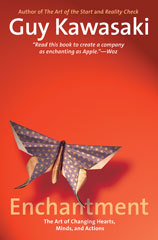
Enchantment: The Art of Changing Hearts, Minds and Actions

Enchantment Enchantment: The Art of Changing Hearts, Minds, and Actions


By Guy Kawasaki

Published by Penguin Books Ltd

ISBN: 978-1-58184-379-5


Description
Enchantment: The Art of Changing Hearts, Minds, and Actions is Guy Kawasaki's tenth book. In it, he explains how to influence what people will do while maintaining the highest standards of ethics. The book explains when and why enchantment is necessary and what the pillars of enchantment are: likability, trustworthiness, and a great cause. The next topics are launching, overcoming resistance, making enchantment endure, and using technology. There are even chapters dedicated to enchanting your employees and your boss. Finally, because there are times you may want to resist enchantment, there is even a chapter about how to do this too. If you want to change the world - or even part of the world, this book is for you.

Commentary
I usually review books about Corporate Social Responsibility (CSR) and Sustainability, and Enchantment does not pretend to fall into these categories. However, there is nothing more fundamental to ensuring a sustainable future than the preservation of relationships, ethics and positive interactions with all we meet and with whom we interact. In this sense, Enchantment is the ultimate required reading for CSR and Sustainability; it precedes and prepares us for the entire journey of changing the world based on universal values and respect for all.

Enchantment is not the product of a scientific research program nor is it a collection of corporate case studies that define sustainability processes. It is the product of Guy Kawasaki's collective experiences, coupled with his intelligent development of an innovative basic behavioral model which can be summarized in one sentence: Enchantment will save the world.

At the heart of this book, is a compelling definition of enchantment which gives this word new meaning and an empowering platform with which we can immediately identify. Enchantment "causes a voluntary change of hearts and minds and therefore actions. Enchantment transforms situations relationships. It converts hostility into civility. It reshapes civility into affinity. It changes skeptics and cynics into believers." When you want to enchant people, you want to fill them with "great delight".

The book, Enchantment, is a how-to guide, describing the multiple situations in which you can genuinely and authentically enchant your colleagues, friends, family, associates, employees, your boss and even yourself in order to promote a worthy cause. Ranging from "Disclose your interests" (a key component of trustworthiness), to "Conduct a Premortem" (preventing potential problems in order to increase the likelihood of success) to "Make it Short, Simple and Swallowable" (when creating marketing messages) to "Default to Yes" (adopt a yes attitude, which buys you time, enables you to see more options and builds rapport), the book is peppered with chunks of great advice on how to build an enchanting attitude, behavioral framework and actually, way of life. Enchantment also applies in the world of social media (maybe, especially in the world of social media), and Guy Kawasaki includes two chapters on enchantment in email, twitter, websites, blogs, Facebook and other online hangouts. One of my favorite sections is the one called "Think Japanese", where lessons from Japanese wisdom inspired by Garr Reynold's book, Presentation Zen Design, such as Kanso, Shizen, Datsuzuko, Seijaku, Wa and Ma, will "make people think you're smart and more enchanting" (unless you are Japanese and this is your mother tongue, I guess) and also provide some useful insights. Personal stories from interesting personalities are offered throughout the book, showing how they have applied or experienced enchantment in practice.

But, getting back to CSR and Sustainability. There are some enchantment themes which are directly relevant to sustainability programs. "Diversify the Team" is one. "A diverse team helps make enchantment last because people with diverse backgrounds, perspectives and skills keep a cause fresh and relevant." "Empower your employees to do the right thing" is another - because employees care, and "money isn't their sole motivation". Also, ethics gets a mention - "not everyone is an ethical enchanter" - and Guy makes the case for resisting situations in which ethics might be compromised - rather like Code of Conduct training.

All in all, this is a short book with a powerful message which, actually, does enchant as you read it. Guy Kawasaki radiates throughout his book a certain nice-guy authenticity which makes his message credible and gives you an insight into how he has achieved wide acclaim and success as founder of Garage.com and Alltop.com and advisor to many technology and social media ventures, as well as being a popular speaker and writer.

For all those struggling to sell CSR in organizations or those who want to achieve transformational results in promoting the cause of sustainability or simply improve relationships, Enchantment is well worth the read and will leave you, yes, enchanted.


elaine cohen, CSR consultant, Sustainabilty Reporter, HR Professional, Ice Cream Addict. Author of CSR for HR: A necessary partnership for advancing responsible business practices  Contact me via www.twitter.com/elainecohen  on Twitter or via my website www.b-yond.biz/en

Thursday, September 23, 2010

Giving Voice to Values


Giving Voice to Values: How to Speak Your Mind when You Know What's Right


By Mary C. Gentile

Publisher: Yale University Press ISBN-13: 978-0300161182

This review first appeared on CSRwire.com on 23rd September 2010


Description

How can you effectively stand up for your values when pressured by your boss, colleagues, customers or shareholders to do the opposite?

Educator Mary Gentile empowers business leaders with the skills to voice and act on their values and align their professional path with their principles. Her book, Giving Voice to Values, is inspired by a curriculum Gentile launched at The Aspen Institute with Yale School of Management, now housed at Babson College, with pilot programs in over 100 schools and organizations on five continents.

Challenging the assumptions about business ethics at companies and business schools, she argues that often the issue isn't distinguishing what is right or wrong, but knowing how to act on your values despite opposing pressure. Drawing on actual business experiences as well as social science research, Gentile offers advice, practical exercises and scripts for handling a wide range of ethical dilemmas. Published by Yale University Press, Giving Voice to Values is an engaging, innovative and useful guide that is essential reading for anyone in business.

Commentary

There is something, I think, that most people overlook in training on ethics and the assimilation of values in business, and that is how you actually put the theoretical knowledge in to practice. It's a little like knowing the calorie count of all the food on your daily menu, but having difficulty actually getting started with, and maintaining, that low-calorie diet. Giving Voice to Values, then, is a habit, perfected by practice, not simply a state of mind. This is the focus and unique value that this book, by Mary C. Gentile, a ten year veteran of Harvard Business School and a pioneer in the fields of business ethics and diversity management, brings to the table.

"Whistle-blowing," which is what all corporate Codes of Ethics require from employees, is a term which has a certain negative connotation. It tends to make us think of telling tales, going behind people's backs, in an almost cowardly and sneaky way. Yet ethical behavior, I believe, never goes unnoticed. There is always someone in any business organisation that knows what's going in, even if they have not been directly complicit in unethical behavior. The success of corporate ethics rests with the individual employee who is prepared to speak up for the values of the business, which hopefully coincide with her or his own personal values, even when this means confronting or whistle-blowing on the behavior of colleagues. Most of us that work in the field of ethics know that getting employees to speak up when they suspect colleagues of unethical behavior is the hardest aspect of any program, even harder than standing your ground when asked to go against your values. The organizational context that enables or disables the voicing of values is not always apparent and can influence individuals in many ways. This book is a welcome and refreshing addition to the many books out there that have been written on the subject of ethics in business because it focuses on how to voice values, and not what values to voice. It's not about persuading us that certain values are more appropriate than others, it's about helping us ensure we are capable of acting on our chosen values. In any organisation, writing the Code of Ethics is the easy bit, publishing it to all employees is also not complex, even conducting training or producing on-line primers on ethics is not so challenging. Truly embedding a culture of ethics which compels every individual to take personal responsibility and act ethically in every situation is what makes it all work. This book offers practical advice on how to "build the muscles" to speak and act, plan "voicing values," "craft scripts" and generally be prepared for a range of situations in which bold action is required. As the author says, "It is not about deciding what the right thing to do is, but rather about how to get it done."

Mary C. Gentile starts out with examples from a study conducted at Columbia Business School in which incoming MBA students were asked to write about a time when they had experienced a conflict between their values and what they were asked to do in the workplace. Whilst the stories were often similar (adjust billable hours, inflate or deflate numbers, misstate time needed to provide services etc), the responses were often different, highlighting discomfort with such conflicts and the need to be creative in finding the right response. This made me think of a popular reality TV program I enjoy watching, called "What Would You Do?" in which the reactions of unsuspecting members of the public are filmed, as they are unwittingly exposed to scenes involving a values conflict, which are fictitious and staged by actors. These may be something to do with discrimination, dishonesty, violence or abuse. Many walk on by without reacting. Some get stuck in and fight the good fight. Even those who do not react are interviewed and almost always, they knew something was wrong, wanted to get involved but were stopped by fear or other inhibitions.

Considering these scenarios ahead of time, and planning your response ahead of time to the question "What would you do?" can make the difference between speaking up and walking away. The author makes a very strong case for this in Giving Voice to Values.

Mary C. Gentile examines the underlying "attitudes, beliefs and capacities that enable our efforts to voice and act on our values," the types of values that are widely shared (and we generally know what these are), the ability we have to make a choice to confront value conflicts, and ultimately, the normalization of such value conflicts, so that we see them as part of our everyday job, and are prepared as far as possible for the types of corners they force us into. Thereafter, in a chapter entitled "Finding my Voice," the author describes several "enablers" or points to consider in how to formulate your own personal approach to dealing with values conflicts, in a way you are comfortable with. A series of appendices provide primers and exercises to help you develop those value conflict management muscles.

Flavored with a range of anecdotes from the author's vast experience, this book was inspired by a program the author developed at the Aspen Institute together with Yale School of Management. It is easy but certainly not light reading, and it targeted at us, as individuals, rather than at those who develop organizational processes. The central argument is persuasive, and the logic is sound. I therefore recommend this book to everyone who works in a business or leads people in business, or more simply put, I recommend it to everyone. Period.


elaine cohen, CSR consultant, Sustainabilty Reporter, HR Professional, Ice Cream Addict. Contact me via www.twitter.com/elainecohen  on Twitter or via my website www.b-yond.biz/en
Related Posts Plugin for WordPress, Blogger...