NOTE: The URL of this blog is now www.thecsrbooksblog.com. Please make sure your RSS feeds / bookmarks are up-to-date!

Sunday, June 19, 2011

The Age of Responsibility

The Age of Responsibility: CSR 2.0 and the NEW DNA of Business

By Wayne Visser

Published by John Wiley and Sons.

ISBN: 978-0-470-68857-1

This review was first published on CSRwire.com on 15th June 2011


Description

In this landmark book, Wayne Visser shows how the old model of Corporate Sustainability &; Responsibility (CSR) is being replaced by a 2nd generation movement. This generation goes beyond the outmoded approach of CSR as philanthropy or public relations (widely criticised as 'greenwashing') to a more interactive, stakeholder-driven model.

Commentary

The Age of Responsibility: CSR 2.0 and the New DNA of Business is possibly Wayne Visser's greatest work yet. It is deeply reflective of the state of the world, society, business and people who change our lives. It is as much an intimately personal account of Wayne's evolving relationship with Corporate Sustainability & Responsibility as it is a guide to the way these concepts have emerged to drive practices - which have in some ways made a positive difference in the world, but failed spectacularly in other ways to harness the power of capitalism into a force for positive impact.

In many ways Wayne's view of the state of CSR today is rather depressing. Wayne writes: "At worst, CSR in its most primitive form may be a smokescreen covering up systematically irresponsible behaviour. At best, even the most evolved CSR practices might be just a band-aid applied to a gaping wound that is haemorrhaging the lifeblood of the economy, society and the planet." At another level, it is quite uplifting: "We are on the brink of the post-industrial revolution and we need to decide whether we will be accomplices in slowing that transition, or catalysts in speeding us towards a better future." The core message, however, is that CSR as we know it has failed to create a demonstrable improvement in the quality of social, economic and ecological life. For CSR to succeed, it needs to transform itself into something new, CSR 2.0.

Wayne Visser's 9th book on CSR, The Age of Responsibility, is cleverly structured walking us through the "Ages and Stages" of the CSR movement. There are five ages according to the author:

1.The Age of Greed: characterized by "bigger is better" and shareholder rule in which unfettered growth is fueled by the concept that "greed is good" and that corporations who make more money (for shareholders) actually benefit society.
2.The Age of Philanthropy: characterized by the concept that business should give back to society, personified by John D. Rockefeller, Bill Gates and Warren Buffett and categorized by Matthew Bishop and Michael Green as "philanthrocapitalism."
3.The Age of Marketing: characterized by the concept that reputation and brand matter most, leading to CSR for PR gains, with a good measure of greenwashing thrown in.
4.The Age of Management: characterized by the alignment of CSR with business strategy and adoption of voluntary codes and industry standards. Embedding CSR is the name of the game.
5.The Age of Responsibility: characterized by what Wayne Visser calls "CSR 2.0, or Systemic CSR, based on a new set of principles." The Age of Responsibility has been heralded by iconic leaders such as Anita Roddick of The Body Shop, Ray Anderson of Interface and Yvon Chouinard of Patagonia. CSR 2.0 also makes use of the new social media era as business begins to "redefine its role in society."

CSR 2.0 is based on five principles - creativity, scalability, responsiveness, glocality and circularity. Each principle is explained in turn and a host of examples are provided to ensure we understand it can be done. Vodafone's M-PESA service for mobile-phone banking in Africa is an example of creativity. Tata's Nano car and Wal-Mart's conversion to organic cotton are scalable initiatives; while GSK, the pharma giant, showed responsiveness by creating a patent pool for developing drugs for neglected diseases. Glocality is about ensuring the right local solutions, such as the experience of SC Johnson in Kenya who reformulated cleaning products to adapt to local consumer conditions. Circularity takes us in the direction of cradle-to-cradle and examples can be seen from Patagonia, Nike and Timberland, as well as Tesco's promise to be carbon neutral by 2050.

Getting to CSR 2.0 requires inspired, committed and capable people who understand their role in leading change to make the new promise of CSR 2.0 a reality. The final part of The Age of Responsibility is a lesson on change and includes a Change Matrix which plots the many change agents who have emerged to date to advance CSR and several change models that can assist our thinking as we aspire to make it happen.

Wayne Visser distils four types of CSR change agents within the community of CSR professionals: the Expert (whose motivators are projects, systems and technical excellence); the Facilitator (who shares knowledge and creates opportunities); the Catalyst (who initiates change and gives strategic direction) and the Activist (whose motivation is related to broader social and environmental issues in the world). The point is that motivation for change in business organizations comes in different forms and driving change successfully requires recognition of individual motivators and organizational context. At the heart of it all are individuals and their actions.

What is rather unique and appealing about this book is that it is not simply an erudite chronicle of the evolution of CSR together with a nicely packaged solution to all CSR's inadequacies. The appeal is the sense you are actually working through the dilemmas and challenges at each step of the way with the author, who ultimately asks whether working in Corporate Sustainability & Responsibility is a good answer to his life's question: Is advancing CSR truly a worthy enough cause for us to devote our energies to? Or is it a hollow shell that provides capitalism with a softer face but doesn't make any substantive difference to the way businesses work?

From Wayne's early beginnings as a strategy analyst with Cap Gemini, through leadership with KPMG's Sustainability Services in South Africa and then back to academia to pursue a Ph.D., Visser has grappled with the manifestations of the ages and stages of CSR in a way that reflects his deep sense of personal responsibility to make a difference. This journey has led him to develop a vision of a new CSR, which is more holistic and "judged by its success in improvements in the overall socio-cultural, economic and ecological system." In the forward to the book, the Age of Responsibility protagonist Jeffrey Hollender writes: "The hour may be late and the clock loudly ticking, but the story of responsible business is not over yet. There's still room for a happy ending. And the time has come to write it for ourselves."

We should all read this book. We are all potential change agents. We are all part of the problem and part of the solution. We are all living in World 2.0, where CSR 2.0 can become a reality. We are all likely catalysts in the Age of Responsibility.

PS Thanks to Wayne for a mention of ME on page 259 :)

elaine cohen, CSR consultant, Sustainability Reporter, HR Professional, Ice Cream Addict. Author of CSR for HR: A necessary partnership for advancing responsible business practices  Contact me via www.twitter.com/elainecohen  on Twitter or via my website www.b-yond.biz/en

Saturday, June 11, 2011

The Whistleblower


By Kathryn Bolkovac and Cari Lynn

Published by Palgrave Macmillan

ISBN: 978-0-230-10802-8


Description

When Nebraska police officer and divorced mother of three Kathryn Bolkovac saw a recruiting announcement for private military contractor DynCorp International, she applied and was hired. Good money, world travel, and the chance to help rebuild a war-torn country sounded like the perfect job. She was soon shipped to Bosnia, where DynCorp had been contracted to support the UN peacekeeping mission. She was assigned as a human rights investigator, heading the gender affairs unit. The lack of proper training provided to her sounded an alarm bell, but once she arrived in Sarajevo, she found out that things were a lot worse than she imagined. At great risk to herself, Kathy began to unravel the ugly truth about officers involved in human trafficking and forced prostitution, and their connections to private mercenary contractors, the UN, and the U.S. State Department. Soon, she was demoted, then fired. Feeling threatened with bodily harm, she fled the country, bringing the incriminating documents with her. Thanks to the evidence she had collected, Kathy won a lawsuit against DynCorp, finally exposing what they had done. Here, Kathy warns of the inherent danger when we contract out our wars and that it is our responsibility to protect the weak and disenfranchised in times of peace. Both gripping and inspiring, this amazing true story of courage and honour in the face of insurmountable odds shows that just one voice can make a difference.

Commentary

Now an award-winning movie taglined "a drama based on the experiences of Kathryn Bolkovac, a Nebraska cop who served as a peacekeeper in post-war Bosnia and outed the U.N. for covering up a sex scandal," The Whistleblower is much more than that. It's an exposure of the worst kind of corruption, human rights abuse, vile self-interest, lies, fabrications and corporate cover-ups present at the intersection of the United Nations, the U.S. Government and military contractors who exploit tax-payers' money by complying with human rights crimes in the name of peace. It is also the compelling story of a woman who refused to remain silent about these abuses in the face of significant personal danger. It's a lesson for everyone involved in allocation of national budgets and procurement about the controls necessary to administer contractors and the way they fulfill their responsibilities. It's also a drama, a love-story, an action-packed thriller and a fascinating read. For anyone involved in corporate responsibility, it's a case study about ethics, human rights and the need to protect those who speak out about corrupt practices in business. Finally, it's a wake-up call to shake all those in positions of authority out of complacency and complicity and urge them to clean up the system.

Kathy Bolkovac's story begins when she applies for a role in the International Police Task Force (ITPF) in Bosnia in 1998. The organization providing these "rent-a-cop" services is DynCorp International, "a global government services provider in support of U.S. national security and foreign policy objectives, delivering support solutions for defense, diplomacy, and international development." In this case, the contract was in the framework of the UN mandated IPTF in Bosnia and Herzegovina (formerly Yugoslavia) following the Serbian attack on Sarajevo and the ensuing war for which Slobodan Milosevic was later charged with genocide. The ITPF is composed of UN member countries' national police force representatives. The U.S., not having a national police force, would play its role through providing the services of private contractors. Enter Dyncorp and their recruitment drive, which propelled Kathy Bolkovac to a role as a Human Rights Investigator.

It doesn't take the smart, conscientious and rather outspoken Kathy Bolkovac long to realized that all is not kosher in Sarajevo. She quickly starts to fight for the protection of female victims of domestic violence, winning a breakthrough court ruling which would serve as a base to advance programs addressing violence against women in the region, while unraveling the grim details of the involvement of DynCorp personnel in the trafficking of young girls across East European borders, detention of women for prostitution, visits to brothels and holding women captive for all of the above. After facing many setbacks (disappearing files, delaying tactics, intimidation, etc.) in trying to bring these issues to light, in 2000, Kathy sent a desperate email to 50 personnel involved in the Bosnia mission, entitled "don't read this if you have a weak stomach or a guilty conscience." The email detailed the difference between prostitutes and trafficking victims and the stages of how women end up as prostitutes and sexual slaves, imploring all involved in the mission to ensure they serve and protect people rather than playing a role in facilitating and engaging in human abuses and crime. Her boss immediately informed her that her email was "not a good idea" and Kathy was subsequently dismissed, ostensibly for falsification of work records, a claim which was entirely fabricated.

Bravely battling against all the corporate muscle DynCorp could muster, Kathy had her day in court (taking home a settlement of a mere $175,000) winning her case for unfair dismissal while exposing the illegal, unethical and irresponsible practices of DynCorp International and their poorly trained, inadequately managed and ineffectively deployed personnel. Kathy ends her account of her own story by making some recommendations on policies for police officers recruited for international missions. Kathy writes: "I have spent many sleepless nights… wondering why these blatantly illegal behaviors were simply allowed to be swept under the rug. And yet reports of immoral and illegal behavior among DynCorp's civilian peacekeepers …continue to make front page news with alarming regularity." You can get a sense of this from Corpwatch's Dyncorp page.

Beyond the personal story of heroine Kathy Bolkovac and the horrors of how she was treated for simply doing her job, as well as anger about the plight of defenseless women caught up in immoral exploitation, this book is an eye-opener about the inner workings of a highly profitable industry which should be head and shoulders above the rest in terms of protecting human rights, revealing it to be a hotbed of the worst kind of intrigue, politics and abuse. Questions about the responsibility of the U.S. government in monitoring the activities of its contracted service providers as well as the integrity of this multi-billion dollar corporation remain in your mind. Despite DynCorp's Code of Ethics, complete with Q and A's, The Whistleblower leaves you with a sense of despair that so much is yet to be done while few people are prepared to speak out and be accountable. The Whistleblower is a sobering, important read with all the romance, tension and intrigue of a bestseller title in the crime fiction category. Regrettably, this one is actually true. Oh, and I can't wait to see the movie.

elaine cohen, CSR consultant, Sustainabilty Reporter, HR Professional, Ice Cream Addict. Author of CSR for HR: A necessary partnership for advancing responsible business practices Contact me via www.twitter.com/elainecohen  on Twitter or via my website www.b-yond.biz/en

Tuesday, May 10, 2011

CSR Author Spotlight: Veronica Scheubel

Snapshot:
Born in: St-Jean-sur-Richelieu, Quebec, Canda
Lives in: 'The Vermont of Germany,' the Red Hair Mountains (about 100 miles east of Cologne and north of Frankfurt) with German high school sweetheart, after 22 years apart.
Educated at: Educated at: Baccalaureate in Germany, Political Science at Concordia University in Montreal and Masters in Organisation Consulting at Ashridge Business School in the UK.
Favorite CSR Book: Adrian Hodges' and David Grayson's Everybody's Business, as it was the first book to educate the world about CSR.
Favorite non-CSR book: Kenneth Leung's The Zen Teachings of Jesus (it's not a religious book); Edward Said's Representations of the Intellectual, Milan Kundera's Immortality.
Favorite movies: 'Il Postino,' 'Monsoon Wedding,' 'Smoke,' 'Smoke Signals,' 'The Royal Tenenbaums,' 'Gosford Park,' 'Lisbon Story,' 'Lost in Translation,' 'Eat Drink Man Woman'.
Favorite musician: Jazz trumpet player Chet Baker on 'The Best of Chet Baker Sings'
Favorite CSR report: SAP - for being accessible from mobile tablets, for the interaction and engagement, for the view of developing sustainability reporting as a journey.
If I could, I would ...: Go live in Buenos Aires for a year or two and then explore business opportunities in India!


Having co-authored, with Nick Lakin, number 7 on the Cambridge University Sustainability Leadership Programme's top sustainability books of 2010, together with over 10 years of hands-on business practice and consulting experience, Veronica Scheubel, former Senior Corporate Responsibility Manager at Nokia, is a superstar amongst experts in how to mastermind and execute ways for businesses to engage with the community. Her book, Corporate Community Involvement: The Definitive Guide to Maximising your Business' Societal Engagement, (Greenleaf, 2010) is the most comprehensive, practical and well-researched guide available for those wishing to devise, plan, manage and succeed in delivering business engagement with local communities and employee volunteering programs. According to Veronica, there was a clear gap in the market for this kind of book: "Nick and I noticed that between the two of us, we had written so many internal company manuals on how to practice Community Involvement from inside a company. Nick asked why nobody had ever thought of turning this into a book, so companies don't have to re-invent the wheel. He convinced me that the two of us had to do that, so we set out to write our book. Working to a strict schedule, we got it done in 6 months. It helped that we had our previously-written manuals to refer to, and that we had all our personal experience from managing global Community Involvement programs to draw on."

Since publication, Corporate Community Involvement has generated positive reactions. Veronica mentions that "quite a few people have contacted us to let us know that they found the book really useful, particularly the Chapters on Strategy, Employee Involvement and how to operate as a company-internal change agent." According to Veronica, the most important messages in the book for succeeding in community involvement are: "Be strategic and contribute your company's core competencies, engage in real cross-sector partnerships in the community, and involve key functions in the company as well as employee volunteers."

The practice of community involvement is by no means uniform across all companies, according to Veronica. "As with so many other aspects of corporate life, there are the visionaries, the early adopters, the early majority, the late majority and the laggards. What strikes me after more than 10 years of my own work in this area is that we still have players in every field! We have visionaries like IBM, early adopters like Nokia, many companies in the early majority, but shockingly many companies still in the late majority that are still dabbling in philanthropy and are only just discovering Community Involvement. And then of course, there are laggards that still claim Community Involvement is not relevant to them and that shareholder value is all that counts ... The 'early' half encourages and enthuses me while the 'late' half creates the gap versus my expectations and shows me that there is still so much more work to do!"

Most of Veronica's professional time is spent in organizational change and corporate responsibility consulting, training, executive coaching, team development and Action Learning. She is also active in The Partnering Initiative at the International Business Leaders Forum in London which leads in matters relating to cross-sector collaboration. Veronica is an Associate, offering training, facilitation and mediation, including a three-day certification training in cross-sector partnering practice, offered in different countries. In addition, Veronica and her partner bought a home with a garden and, for the past two years, have been busy with renovation and redecoration. They both enjoy travel and the sun, hiking, cooking and nice restaurants, movies and good books. Every few days, they 'borrow' the neighbor's four year-old twin boys for a play session which is fun for all.

But this does not prevent Veronica from considering what her next book will focus on: "A few colleagues and I are really passionate about the opportunities of bringing organizational change consultants together with Sustainability Managers in companies, as we have experienced first-hand how much can be achieved for embedding Sustainability throughout an organization when both work together and pool their knowledge, resources and approaches. It is still a very new message out there, and we are a small cohort, but we'd like to spread the word and the practice, so there will have to be a book about it!"

Indeed, Veronica has a passion for making change in organizations more accessible. "The world is changing, and participative approaches within organizations as well as with stakeholders will become increasingly important and unavoidable. This is where I see a focus of my work - I'd like to support people in organizations, who might be used to the 'old ways' and perhaps a bit unused to and afraid of 'sharing power', in familiarizing themselves with new concepts, trying them out and experimenting with them. As a facilitator, I can help create a 'safe environment' for that." As Francois de la Rochefoucauld once said, "The only constant thing in life is change." Anyone who can help us navigate that is playing an important role in society, and Veronica, both in her practice and with her book, surely demonstrates what it means to be an agent of change.

I would like to thank Veronica Scheubel for sharing her insights and for her great guide to Corporate Community Involvement which features highly on my always-keep-close book list.


elaine cohen, CSR consultant, Sustainabilty Reporter, HR Professional, Ice Cream Addict. Author of CSR for HR: A necessary partnership for advancing responsible business practices  Contact me via www.twitter.com/elainecohen  on Twitter or via my website www.b-yond.biz/en

Monday, May 9, 2011

The HIP Investor


By R. Paul Herman

Published by John Wiley and Sons Ltd

ISBN: 978-0-470-57521-3


Description

In The HIP Investor: Make Bigger Profits by Building a Better World, R. Paul Herman - creator of the HIP methodology and a leading investment manager - introduces a systematic approach for investors that is designed for more attractive profits and positive human, social, and environmental impact. Based on comprehensive research of the S&P 500, HIP assesses and values measurable results over well-intentioned policies and philosophies, and shows how higher-performing companies can deliver both human impact and profit for shareholders. This HIP approach is shown to outperform the financial returns of the S&P benchmark in both up and down markets.

Written for investors of all types and their financial advisors, this detailed guide will help you construct a portfolio of firms that are boosting their bottom line by meeting five core human needs. Leading firms benefit customers, engage employees, and deliver sustainable, profitable growth for their investors through innovative products, measures, and decision making. Each chapter reveals a fundamentally strong analytical approach enriched with real-world case studies that show you how your portfolio can capture substantial financial returns and generate positive impact while also mitigating risks.


Commentary

Whether you are an investor or not, The HIP Investor will teach you a lot about how businesses can make profit while having a positive impact on society and environment. The Hip Investor is not a theoretical discussion. It's a highly practical, well-researched, coherent encyclopedic guide, full of examples of how businesses have leveraged their capabilities to create better business and a better world. The proof is that the HIP (human impact and profit) investment portfolio outperforms multiple benchmarks , for example, the HIP 100 has done 4 percent better than the S&P 100 every year between mid-2004 and 2009.

The HIP methodology was masterminded in 2004 by R. Paul Herman, after he gained a finance degree at Wharton and worked at McKinsey & Co. on incentive regulation in the energy sector and advised Fortune 500 corporate clients on investments. The HIP method identifies five core dimensions of the way companies drive financial, social and environmental value through innovating new products that improve the quality of life, operating with higher environmental efficiency and effectively managing their social impacts. An analysis of the extent to which a company embraces the concepts and practices in these five dimensions can produce a HIP Scorecard with over 20 indicators whose value indicate positive results for society, thereby providing a useful tool for investors, because, "typically, the better the human impact performance, the bigger the profits". The HIP methodology overlap to a large degree with other leading rankings of corporate responsibility or sustainability practices, though it also offers a fresh way of looking at companies and their impacts, providing specific quantifiable metrics in each of the five HIP dimensions.

The five core dimensions of the HIP methodology are:

1.Health: refers to both physical and mental well-being, including quality of life.

2.Wealth: encompasses ways for people to earn more, save more or better secure their financial future.

3.Earth: covers the water we drink, the air we breathe and the overall ecosystem balance.

4.Equality: seeks fair representation, whether classified by gender, ethnicity or income class.

5.Trust: includes open, transparent information and ethical and respectful behavior.

The HIP investor builds an investment portfolio using data collated and analyzed in these five categories to produce an overall performance scorecard, showing how HIP a company is, and how the company's HIPness stacks up against other companies in the same sector or in general.

The author has not been content to simply explain the methodology. The HIP Investor is one of the most extensive and detailed catalogs of corporate sustainability-related practices as I have read in the past few years. Examples abound from almost every company you can think of, from the leaders to the laggards, culminating in a persuasive argument which substantiates the need for a HIP mindset, HIP practices, HIP analysis and HIP investing. Additionally, the author presents a set of sector "face- offs" comparing the HIP scores of giants such as PepsiCo / Coca Cola, Procter and Gamble / Colgate-Palmolive, Dow / DuPont, Raytheon / Lockheed Martin, Verizon / Sprint, J.P. Morgan Chase / Bank of America, McDonald's / Starbucks, Microsoft / Apple, Walmart / Target and Chevron / ExxonMobil, which have also been published on Fastcompany.com.

In the final sections of the book, the author teaches potential investors how to build a HIP investment portfolio, maintaining that the HIP approach leads to more appropriate valuations than sector-weighted approaches as adopted by S&P 500 and others and providing insight on a wide range of investment options. Finally, R. Paul Herman ends up with his optimistic view that a HIP world is possible and that investors have the power to create it and reap the rewards, both in financial and non-financial terms. A HIP world is one where corporations compete in areas which add positive social and environmental impact. With $175 trillion in global financial assets available to investors, Herman maintains that there is certainly a sufficient supply of capital to make a HIP difference.

R. Paul Herman makes a convincing argument for HIP. Understanding companies from a perspective of the three core HIP investor questions (How HIP are the company's products? How is the company measuring its human, social and environmental impact? How do existing management practices reflect a HIP approach?) presents a novel way of evaluating companies' long-term sustainability and predicting their long-term financial performance. Using the 5 core HIP scorecard factors to assess companies provides a tangible framework for investment decision making. Even if you are not an investor, you are probably a customer, an employee, a supplier or even a community member and the HIP approach can help you decide whether to engage with a company in one way or another. I guess that to write a book about HIP investment, you have to be pretty HIP yourself, so I find myself compelled to round of this review with three cheers - HIP HIP Hurray - for the highly HIP R. Paul Herman and The HIP Investor.

elaine cohen, CSR consultant, Sustainabilty Reporter, HR Professional, Ice Cream Addict. Author of CSR for HR: A necessary partnership for advancing responsible business practices Contact me via www.twitter.com/elainecohen  on Twitter or via my website www.b-yond.biz/en

Friday, April 29, 2011

Trafficking for Begging: Old Game, New Name

Trafficking for Begging: Old Game, New Name


By Iveta Cherneva

Published by Amazon Digital Services.

ASIN: B004J4X1AE

This review was first published on CSRwire.com on 25th April 2011


Description

Trafficking for Begging: Old Game, New Name describes an ugly industry; the exploitation of beggars is a form of human trafficking. The book gives a voice to the thousands of victims and uncovers details of this criminal activity. Apart from the legal and social discussion, the study also looks into psychological theories as to why people give money to beggars. The author suggests ideas for public campaign messages that can break the exploitative cycle of trafficking for begging based on these psychological theories. If you liked the movie Slumdog Millionaire, it is likely that you would also be touched by the main message brought by Trafficking for Begging: Old Game, New Name.


Commentary

This is an important book which will not, regrettably, be mainstream reading for anyone in a corporate setting. The subject of trafficking in humans (especially children) for the purpose of begging and profiteering is one of the low sides of our society which prevails around us and which, as responsible citizens, we should be acutely aware of. I am reminded of several trips to India some years ago where it was impossible to move more than a few meters without being approached by a child asking for money. I recall one particular young girl, carrying a disabled baby in her arms, who touched my heart as she begged me to buy powdered milk for her baby brother and took me down several Mumbai alleys to a kiosk selling cans of powdered milk. My colleagues laughed at me when I recounted the story. In my naiveté, I had not imagined that the infant was not actually her brother. I didn't contemplate that she may have another unfortunate child caught into the web of begging, probably "owned" by someone who would profit from the cash after the tin of powdered milk was returned to the kiosk to wait for another unsuspecting business person or tourist.

Iveta Cherneva has published an important work, exposing the intricate operations of begging traffickers in Western Europe, as well as in emerging economies. Yes, even in Geneva, Switzerland, "amidst the wealth and seemingly calm social landscape, an Ugly Industry is quietly sitting on the pavement." Iveta Cherneva says that victims of human trafficking are "part of a ring with organizational complexity comparable to that of a medium-size business enterprise." In Trafficking for Begging, she exposes the factors behind trafficking and the "business" decisions that traffickers make in order to boost profits: "Beggars are forced, abused, beaten and even mutilated by their begging pimps in order to cause more pity. Cut On Purpose. Blinded On Purpose. With broken limbs On Purpose. Without an arm On Purpose."

There are many forms of exploitation and trafficking which for most of us will be simply inconceivable in their cruelty and abuse of human life and human rights. These might include "mail order brides, domestic servitude and nannies, recruitment of child soldiers, illegal adoptions, trafficking for ritual purposes and trafficking of prisoners, camel jockeys, drug smuggling, petty theft, construction and agricultural work, etc." Just reading this list engenders reactions of outrage and great sadness.

Iveta says that "One of the main aims of this book is to suggest an emerging paradigm shift on the international, regional and national level indicating a move away from a purely law enforcement approach to a human rights victims-centered approach. That would hopefully result into a change of mindset in policy making and full-fledged protection and assistance to trafficking victims." In Sweden, for example, this means outlawing the practice of prostitution by punishing the client and protecting the victim. Iveta Cherneva maintains that "by giving money to beggars on the street we only encourage the vicious cycle, which fuels the criminal activity."

Trafficking for Begging is based on the author's observations in Switzerland and much research in international law and domestic legislation from around the world. This self-published book includes some personal stories from begging victims, but it is mainly an intelligent and detailed overview of international legal frameworks that cover trafficking, exploitation and begging in all their forms and a proposal for a policy direction that could assist in curtailing the effects of such difficult issues our society must face.

Whilst this subject might not be directly related to CSR policy in most companies, it is certainly related to sustainability and the creation of a just and equitable society for all. How many corporations use their funds and influence to fight this type of crime against humanity in the same way as they poor funds into education, health and other more "acceptable" social needs? The Body Shop, always a company to champion a less popular cause, has made anti-trafficking a flagship program, and there may be others. Perhaps Iveta Cherneva's book may spark more initiatives, especially for companies who operate in regions of high-risk for begging trafficking, which, it seems, can be just about anywhere. In any event, reading Trafficking for Begging is a sobering experience and Iveta Cherneva earns my admiration for skillfully bringing this subject onto the radar.


elaine cohen, CSR consultant, Sustainabilty Reporter, HR Professional, Ice Cream Addict. Author of CSR for HR: A necessary partnership for advancing responsible business practices  Contact me via www.twitter.com/elainecohen  on Twitter or via my website www.b-yond.biz/en

Tuesday, April 26, 2011

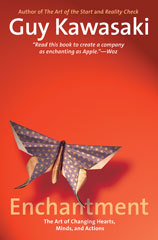
Enchantment: The Art of Changing Hearts, Minds and Actions

Enchantment Enchantment: The Art of Changing Hearts, Minds, and Actions


By Guy Kawasaki

Published by Penguin Books Ltd

ISBN: 978-1-58184-379-5


Description
Enchantment: The Art of Changing Hearts, Minds, and Actions is Guy Kawasaki's tenth book. In it, he explains how to influence what people will do while maintaining the highest standards of ethics. The book explains when and why enchantment is necessary and what the pillars of enchantment are: likability, trustworthiness, and a great cause. The next topics are launching, overcoming resistance, making enchantment endure, and using technology. There are even chapters dedicated to enchanting your employees and your boss. Finally, because there are times you may want to resist enchantment, there is even a chapter about how to do this too. If you want to change the world - or even part of the world, this book is for you.

Commentary
I usually review books about Corporate Social Responsibility (CSR) and Sustainability, and Enchantment does not pretend to fall into these categories. However, there is nothing more fundamental to ensuring a sustainable future than the preservation of relationships, ethics and positive interactions with all we meet and with whom we interact. In this sense, Enchantment is the ultimate required reading for CSR and Sustainability; it precedes and prepares us for the entire journey of changing the world based on universal values and respect for all.

Enchantment is not the product of a scientific research program nor is it a collection of corporate case studies that define sustainability processes. It is the product of Guy Kawasaki's collective experiences, coupled with his intelligent development of an innovative basic behavioral model which can be summarized in one sentence: Enchantment will save the world.

At the heart of this book, is a compelling definition of enchantment which gives this word new meaning and an empowering platform with which we can immediately identify. Enchantment "causes a voluntary change of hearts and minds and therefore actions. Enchantment transforms situations relationships. It converts hostility into civility. It reshapes civility into affinity. It changes skeptics and cynics into believers." When you want to enchant people, you want to fill them with "great delight".

The book, Enchantment, is a how-to guide, describing the multiple situations in which you can genuinely and authentically enchant your colleagues, friends, family, associates, employees, your boss and even yourself in order to promote a worthy cause. Ranging from "Disclose your interests" (a key component of trustworthiness), to "Conduct a Premortem" (preventing potential problems in order to increase the likelihood of success) to "Make it Short, Simple and Swallowable" (when creating marketing messages) to "Default to Yes" (adopt a yes attitude, which buys you time, enables you to see more options and builds rapport), the book is peppered with chunks of great advice on how to build an enchanting attitude, behavioral framework and actually, way of life. Enchantment also applies in the world of social media (maybe, especially in the world of social media), and Guy Kawasaki includes two chapters on enchantment in email, twitter, websites, blogs, Facebook and other online hangouts. One of my favorite sections is the one called "Think Japanese", where lessons from Japanese wisdom inspired by Garr Reynold's book, Presentation Zen Design, such as Kanso, Shizen, Datsuzuko, Seijaku, Wa and Ma, will "make people think you're smart and more enchanting" (unless you are Japanese and this is your mother tongue, I guess) and also provide some useful insights. Personal stories from interesting personalities are offered throughout the book, showing how they have applied or experienced enchantment in practice.

But, getting back to CSR and Sustainability. There are some enchantment themes which are directly relevant to sustainability programs. "Diversify the Team" is one. "A diverse team helps make enchantment last because people with diverse backgrounds, perspectives and skills keep a cause fresh and relevant." "Empower your employees to do the right thing" is another - because employees care, and "money isn't their sole motivation". Also, ethics gets a mention - "not everyone is an ethical enchanter" - and Guy makes the case for resisting situations in which ethics might be compromised - rather like Code of Conduct training.

All in all, this is a short book with a powerful message which, actually, does enchant as you read it. Guy Kawasaki radiates throughout his book a certain nice-guy authenticity which makes his message credible and gives you an insight into how he has achieved wide acclaim and success as founder of Garage.com and Alltop.com and advisor to many technology and social media ventures, as well as being a popular speaker and writer.

For all those struggling to sell CSR in organizations or those who want to achieve transformational results in promoting the cause of sustainability or simply improve relationships, Enchantment is well worth the read and will leave you, yes, enchanted.


elaine cohen, CSR consultant, Sustainabilty Reporter, HR Professional, Ice Cream Addict. Author of CSR for HR: A necessary partnership for advancing responsible business practices  Contact me via www.twitter.com/elainecohen  on Twitter or via my website www.b-yond.biz/en

Tuesday, April 19, 2011

The Responsible Business: Reimagining Sustainability and Success

The Responsible Business: Reimagining Sustainability and Success


By Carol Sanford

Published by John Wiley and Sons Ltd.
ISBN: 978-0-470-64868-1

This review was first published on CSRwire.com on 19th April 2011.


Description

The Responsible Business offers a new and strategic approach to doing business that holistically integrates responsibility into all aspects of an organization, allowing for returns at every level, business and social. This book goes beyond the often well intentioned but limited attempts at sustainability to present a framework that allows organizations to bring responsibility into everything they do and re-imagine success. From innovation, product development, and production processes to business management, strategic planning, and shareholder development, the author shows how being a Responsible Business is a practical skill that can be applied day-to-day at every level of the business.

 
Commentary

When Carol Sanford speaks, it's well worth listening. In her first book, The Responsible Business, Carol defines what a responsible business is ("a co-creative partner ensuring the vitality and health of all the communities to which it belongs") and what it is not ("a set of metrics to be tracked or behaviors to be modified"). Responsibility is "central to both the purpose and the prosperity of a business and must be pervasive in its practices." Carol goes on to reinforce the concept of responsible business with case studies from her vast experience of consulting to Fortune 500 and other companies, with stories from Herban Feast, Kingsford Charcoal (now part of the Clorox Company), Colgate, Seventh Generation (in the Jeffrey Hollender heyday) and E.I. Du Pont, before summarizing the five recurring themes that turn companies into responsible businesses: Reality - connecting to the real lives of stakeholders; Systemic Effects - as the only measures of success; Systemic Wholes - to combat fragmentation and promote integration; Self-Direction - the redesign of work to "evoke self-directed people doing self-directed work that is self-evaluated within the context of a business strategy" and Capability Development - building critical thinking skills for internal and external stakeholders.

By this time we have come to understand Carol's approach. It is not one where corporate responsibility is a project to be led by a single person or a group. It is a fundamental redesign of the way a business is led, structured, performs and interacts holistically with stakeholders. This is the point at which we meet the Pentad.

The Pentad, the geometrical framework for responsible business, is Carol's own stakeholder model which sees five core stakeholder groups as most significant to overall business success: (1) customers, (2) co-creators (everyone who is involved in creating the product or service for the customer which includes employees, contractors, vendors and raw material suppliers, (3) Earth, (4) communities and (5) investors. This is not light-years removed from the stakeholder models that have contributed to sustainability thinking in recent years, but the uniqueness of Carol Sanford's model is threefold. First, the concept of co-creators as one indivisible group is new, based on the view that employees and suppliers work together toward one shared goal - serving the customer. This approach is arguably much more suited to today's business, where supply chains are often outsourced, than models which separate employees from the rest of the supply chain. Thinking in terms of a supply chain, maintains Carol, "actually destroys understanding of the co-creative process" because the upstream contributors often get overlooked or undervalued. The second unique aspect of the Pentad model is that it has a defined, and not open-ended, number of stakeholders into which everyone connected with the business in whatever way can find a voice. The third aspect of the model is the way it is used. The stakeholder impacts of any decisions are discovered by evaluating each group's interest in turn, and in the Pentad-prescribed order. In this way, stakeholder understanding follows a logical flow, with the most important impacts finding their place in the right order of things, in a way which can enable a company to take the appropriate action, after all impacts have been assessed as part of an indivisible whole and without giving precedence to any stakeholder group. This integrated approach provides the bedrock for the responsible business as part of the universal ecosystem which aspires to help stakeholders live as "responsible and creative contributors to their communities." There is clear merit in this thinking. Stakeholder understanding and engagement is one of the most under-developed aspects of the sustainability movement today. Having an informal chat with a supplier at a conference, or conducting an annual employee satisfaction survey is not stakeholder engagement and it is not a dialog about sustainability. Deep stakeholder understanding comes from discussing the tough issues in a structured way and truly listening to all points of view.

The Responsible Business continues with multiple stories from companies that have applied the Pentad model and the successes they achieved. Taking us through a tour of how the brain works in order to unlock creativity and "conscious choice," Carol builds her case competently and with the wisdom of a business veteran. Much air-time is devoted to the way organizations should be structured to do work of the future and the inappropriateness of many current structures for responsible business. Hierarchies, for example, should not govern decision-making; work teams should be autonomous and self-organizing and learning should be on the job. Ultimately, providing a map of how to become a responsible business and detailing the steps to take, this book forms a sound guide to achieving transformational value.

In The Responsible Business you can read about "urban acupuncture" and the turnaround of a Brazilian city Curitiba, the way Google changed the game on bandwidth auctions, how Procter and Gamble applied their guiding principles in their plant in Lima and how Seventh Generation and Whole Foods worked together in "co-creation" to provide freedom of choice for customers. And much more.

The Responsible Business is an intensive read with a worthy central message, substantiated by years of practical experience and deep insights. For anyone who has not yet subscribed to this approach, the Pentad model may be just what you need.


elaine cohen, CSR consultant, Sustainabilty Reporter, HR Professional, Ice Cream Addict. Author of CSR for HR: A necessary partnership for advancing responsible business practices  Contact me via www.twitter.com/elainecohen  on Twitter or via my website www.b-yond.biz/en
Related Posts Plugin for WordPress, Blogger...